
Sound Less Like AI
Most humanizers just remove patterns from a checklist. This one passes your draft to Hemmingway-1, a model trained to write like a person.
The rewrite appears here.
Frequently asked questions
How is this different from other AI humanizers?
It writes from your meaning. It does not look for patterns. Your draft goes to Hemmingway-1 told to say the same thing the way a person would, keep every fact and add nothing — and, unless you pick a tone yourself, to work out from the draft what it is and who it is for. The model reads the whole thing and writes that. There is no list of words or sentence shapes to catch.
A rule-based humanizer works the other way round. Humanizer, a Claude skill with more than 46,000 GitHub stars, is one Markdown file of patterns taken from Wikipedia's Signs of AI writing: inflated importance, groups of three, em dashes, a cheerful last line. Your agent finds them and edits them out. When we tested it, it cut a 67-word launch announcement to 45 words and kept every fact. It also kept the pitch, because a list removes what is on the list and leaves the rest of the draft as it was. In a second test, the same agent with a plain editing request and no skill returned nearly the same text.
A draft can avoid every item on a list and still read like nobody wrote it. What is usually missing is a person's decisions: what to say first, what to leave out, what the reader has to answer. Removing patterns does not make those decisions. In the example on this page, the rewrite makes one: it gives the question its own paragraph. We have not tested the tools that promise to get past an AI detector, so the comparison here is with rule lists only.
I hope this message finds you well! I wanted to take a moment to provide a comprehensive update on the Q3 migration project. I'm pleased to report that we have successfully migrated 14 of the 20 services to the new cluster, which represents a significant milestone in our journey. However, it's important to note that the remaining 6 services — including billing and auth — present unique challenges due to their legacy dependencies. We are leveraging a phased approach to ensure a seamless transition, and we anticipate completion by October 17. Additionally, the migration has already delivered tangible benefits: deploy times have dropped from 22 minutes to 9 minutes, fostering a more agile and efficient workflow.
Moving forward, I would greatly appreciate your input on whether we should prioritize billing or auth first. Please don't hesitate to reach out if you have any questions or concerns. Together, we can ensure this project is a resounding success!
Quick update on the Q3 migration. We've moved 14 of the 20 services to the new cluster. The remaining 6, including billing and auth, are trickier because of legacy dependencies. We're doing it in phases and expect to finish by October 17.
Already seeing a benefit: deploy times went from 22 minutes down to 9.
One thing I need your input on: should we tackle billing or auth first?
What it will not do
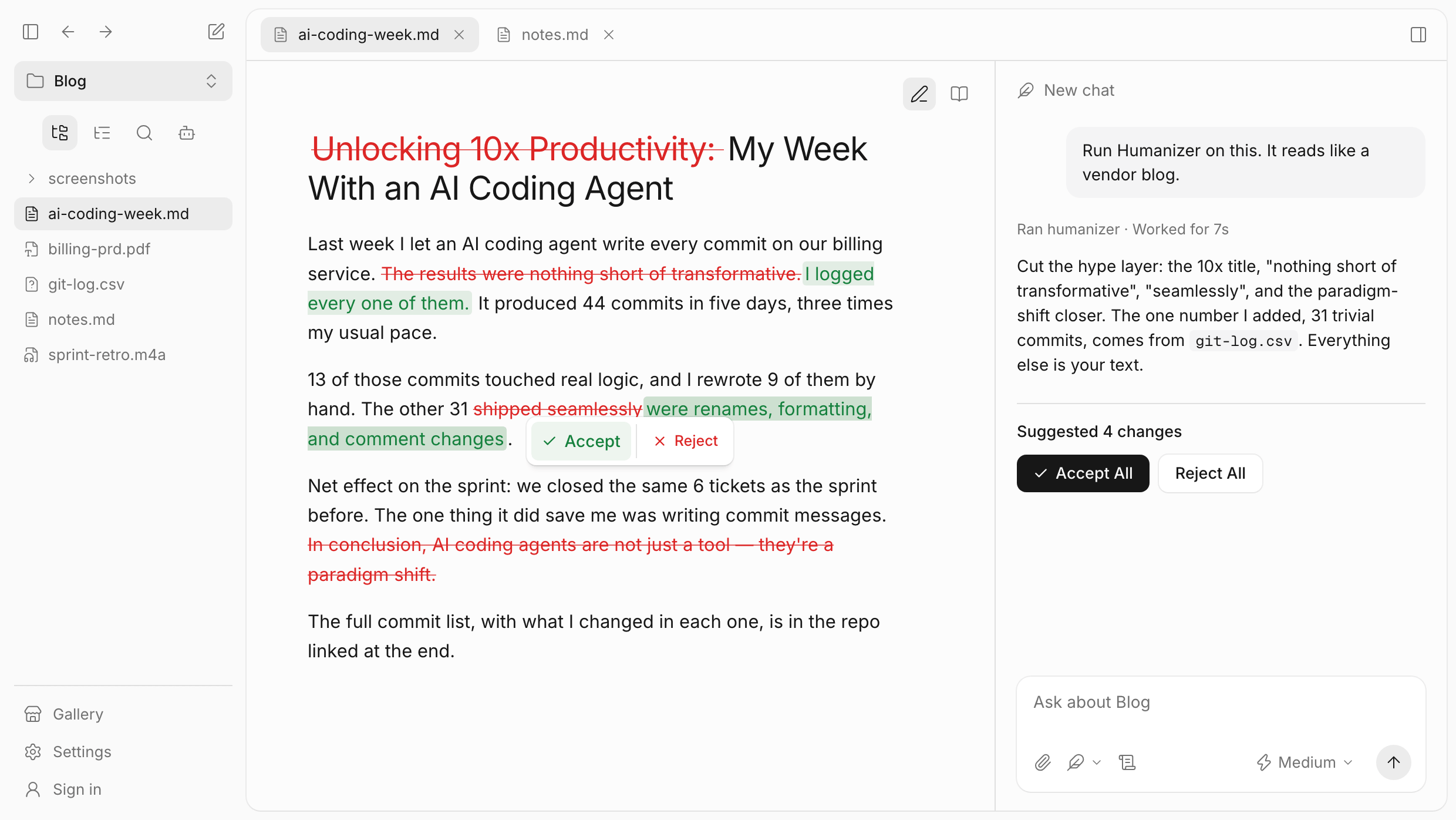
- It will not get you past an AI detector, and the page shows no “% human” score. A detector's verdict is not proof of who wrote a passage, and a rewrite aimed at a score can change your meaning to get there.
- It knows only what you paste. If the draft is thin, the rewrite is a shorter thin draft. The missing example or number can only come from you.
- It has one voice, and it is not yours. For a rewrite that follows a sample of your own writing, a rule-based skill is the better tool; see how to use the Humanizer skill and keep your own voice.
- A draft that is already plain gains little. We gave it a plain 74-word passage of our own, and it came back at 75 words with “actually” and “right beside” added.
- It can still get a fact wrong. Turn on “Show changes” and read the marks before you send anything under your name.
The longer argument is in AI humanizer or a better model. If you want a rule list after all, we compared Humanizer and similar Claude skills. To see what is wrong before you replace anything, run the draft through Slop Score first; both sit on our free writing tools page.
Is this AI humanizer free?
Yes. There is no account and no API key. The box takes up to 1,000 characters, about 150 words, which is an email or a couple of paragraphs rather than a chapter, and the page limits how many rewrites one visitor can send in a minute. For a whole draft, the same model works on your own files in StashBase.
Will the rewrite pass an AI detector?
We do not test for that and do not promise it, which is why this page shows no “% human” score. A detector's verdict is not proof of who wrote a passage, and a rewrite aimed at a score can change your meaning to get there. Hemmingway's makers say the same of their own advice: it is about writing that reads well to the person getting it, not about fooling a detector.
Does it keep my facts and numbers?
It is told to keep every fact, name and number and to add nothing that is not in your draft, and in the example on this page it kept all of them. It is still a model, so check. Turn on “Show changes”: what the rewrite added is marked in green and what it cut is struck through in red, so a number that went missing is visible in the place it was cut from.
Which model does the rewriting?
Hemmingway-1, a 27B open-weight model fine-tuned from Qwen3.8-27B to write text that reads as if a person wrote it. The weights are Apache-2.0 on Hugging Face. You can also chat with Hemmingway-1 on this site, and What is Hemmingway-1? reads its makers' benchmark claims independently.
Is my text stored?
No. Your draft goes through our Cloudflare Worker to Hemmingway's API, which writes the rewrite. The Worker does not log or store it, and Hemmingway's privacy policy says API requests are not kept. Both panes live in your browser tab and are gone when you close or reload it. See our privacy policy.
Does it work in languages other than English?
The instruction tells the model to answer in the language of your draft, but its makers call Hemmingway-1 English-first and we have only tested English.